Clinical trial data integrity
Auditability, timestamping, and protocol amendment tracking inside clinical trials. What ledgers can support and what they cannot replace.
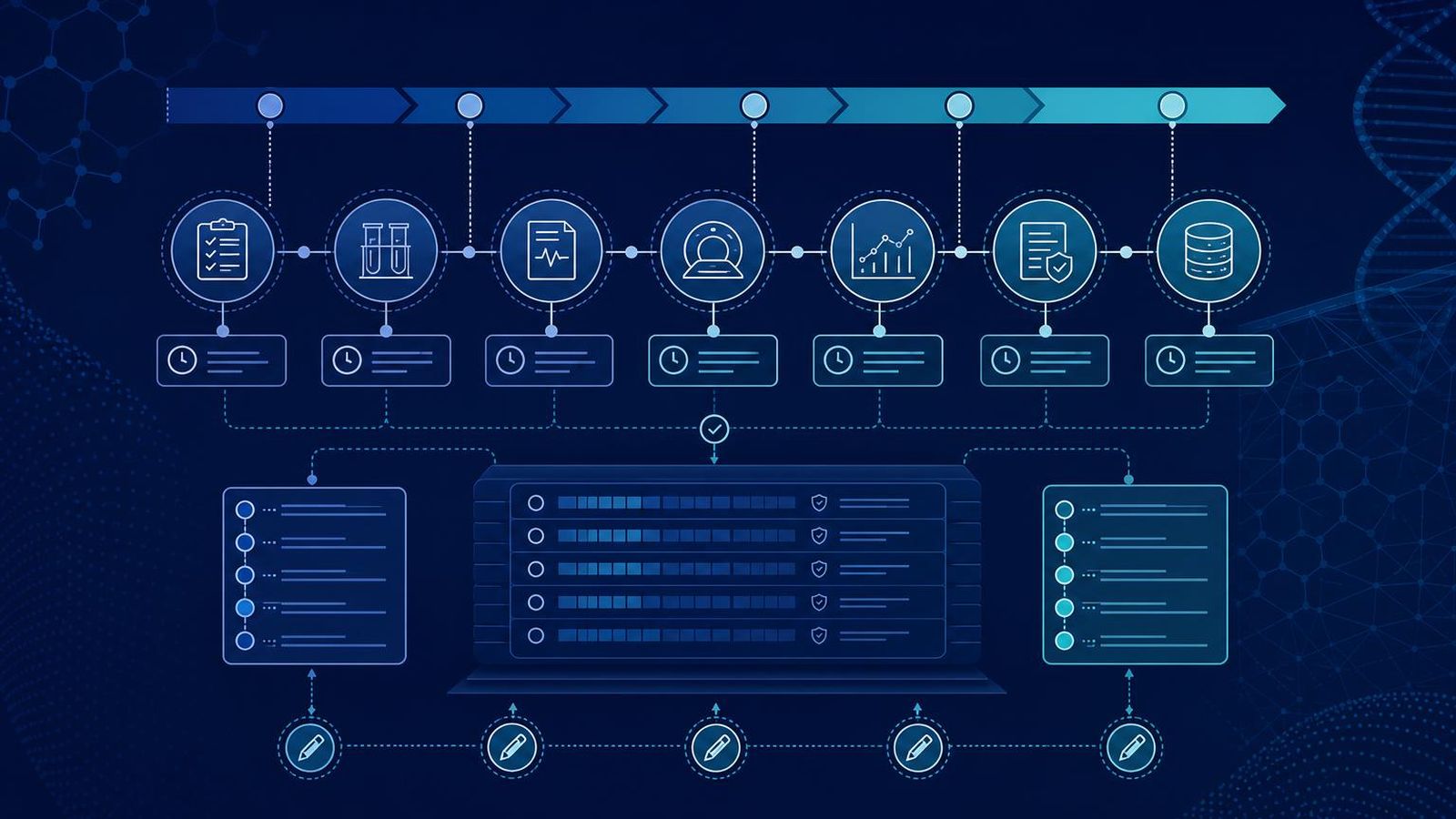
Clinical trials are one of the contexts in which biomedical blockchain has a defensible technical fit. Trial integrity rests on the ability to demonstrate that data was captured when and how it was supposed to be, that protocol amendments were tracked, and that the analysis plan was not adjusted after results were known. Those are exactly the properties a tamper-evident log is good at supporting. The qualifier is that the log supports the property, it does not produce it.
What integrity means in a trial
Trial integrity has several distinguishable elements. Data integrity is the claim that recorded data matches what was observed. Process integrity is the claim that the trial was conducted as the protocol describes. Analytic integrity is the claim that the analysis follows a plan that was specified before unblinding. Reporting integrity is the claim that the results communicated outside the trial match the results obtained inside it.
Different ledger designs touch different elements of that picture. A timestamped log of data capture events supports data integrity. A versioned record of protocol documents and amendments supports process integrity. A pre-registered analysis plan with a hash committed before unblinding supports analytic integrity. A signed result set supports reporting integrity. None of those replaces the trial's quality system. All of them make the quality system's claims more inspectable.
Timestamping that earns its keep
The most useful application is also one of the least flashy: trustworthy timestamps. A timestamp that can be verified independently of the data custodian is genuinely useful, especially in multi-site trials and especially across jurisdictions. The trial does not need to put its data on chain to use such a timestamp. It needs to commit hashes of the data to a chain at the moment the data is captured. The data stays in the trial's existing systems, and the chain carries the evidence that the data existed in its claimed form at the claimed moment.
That pattern is modest, defensible, and easy to operate. It is also one of the few places where a public ledger has clear advantages over a permissioned one, because the independence of the timestamp is part of what makes it useful.
Protocol amendments
Trials amend their protocols. The amendments are not the problem. The integrity question is whether the amendments are tracked clearly and whether they are made before or after their consequences are known. A ledger-backed log of protocol versions, with each version committed and signed at the time of its adoption, makes the timeline harder to revise after the fact. That property has obvious uses for sponsors, regulators, and external reviewers.
The qualifier is that the ledger only documents what was committed to it. A trial that does not commit its amendments to the log will not have an honest log. The design has to encourage or enforce the commitment, usually by making it a precondition for some downstream action that the trial needs to take.
Pre-registration of analysis
The most consequential integrity claim in many trials is that the analysis plan was specified before the results were known. Pre-registration of the analysis plan, with the plan's hash committed to a chain before unblinding, supports that claim in a way that is easy for external parties to verify. It does not prevent post-hoc analyses. It does make post-hoc analyses identifiable as such, which is the relevant integrity property.
This is one of the cleaner uses of the chain in the biomedical research context. The artefact committed is small. The verification is straightforward. The benefit, transparency about what analysis was pre-specified, is exactly the benefit the field has been asking for.
What ledgers do not replace
A trial's integrity comes from its quality system, its monitoring, its source data verification, and the discipline of the people running it. A ledger can support those activities. It cannot generate them. A trial that uses a ledger but does not have a serious quality system is not more credible because of the ledger. A trial that has a serious quality system and uses a ledger to make its claims inspectable is more credible because the claims are inspectable.
The distinction matters when reading proposals. The chain is a substrate for evidence. The evidence comes from the trial's operations. Projects that present the chain as a substitute for the operations are claiming something the technology does not deliver.
Multi-site and cross-jurisdiction trials
The fit improves in multi-site and cross-jurisdiction trials, because the shared log gives parties without prior trust a common reference. A site in one jurisdiction and a sponsor in another can verify the same timestamps and the same protocol versions without having to trust each other's systems. That is a genuine reduction in the operational overhead of multi-party trials. It is also one of the contexts where the chain choice (public vs permissioned) has practical consequences for what counts as adequate independence.
Directory posture
The directory treats clinical trial integrity tooling as one of the better-formed use cases in the field. Inclusion is not endorsement, and confidence labels reflect the maturity of each project's actual deployment. Projects that have operated on real trials are categorised differently from projects that have only run pilots, and projects with only pilots are categorised differently from projects with only proposals.
Related reading
For the privacy posture that interacts with trial data, see privacy and consent. For the regulated software framing that trial systems often sit inside, see software regulation. For directory-level treatment, see the clinical trials use case.