Patient-controlled health records
Patient access, consent dashboards, and the operational reality of putting record control into the hands of people whose lives are full of other things.
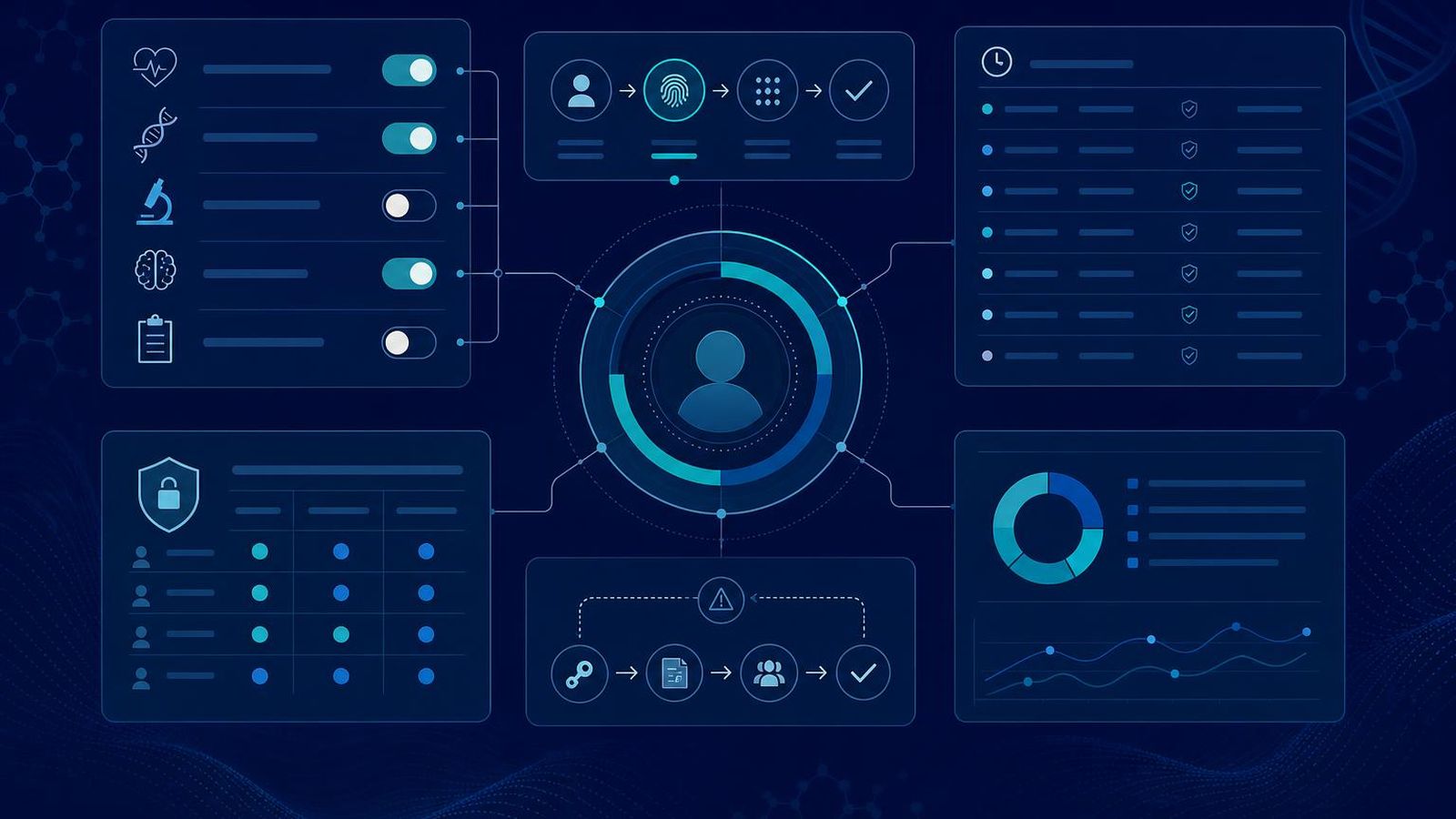
Patient-controlled records is one of the more durable framings in biomedical blockchain. The argument has been around longer than the chain has, and it survives the periodic technology fashions because it appeals to a real frustration. Patients move between providers, repeat the same forms, lose track of what was done, and find that their own records are harder to assemble than they expect. The proposition that the patient should hold the records, or at least the keys to them, has obvious appeal.
What that proposition means in practice depends heavily on choices that are easy to skip past. The choices are about whose threshold of effort the system is designed for, how recovery works when things go wrong, and what fallback exists for people who do not want to manage anything.
Three flavours of "control"
Patient control comes in several flavours that get blurred together. Access control is the patient deciding who can read what. Consent control is the patient deciding what those readers are allowed to do. Custody is the patient holding the actual records or the keys to them. The three are related but separable.
Most credible designs give the patient access and consent control without insisting on full custody. The records continue to sit in storage operated by institutions, and the patient interacts with them through a dashboard. The keys can be held by the patient, held in custody by a chosen custodian, or held in a hybrid arrangement with recovery options. The design space is wider than the slogan suggests.
The wallet problem in this context
The hardest part of patient-controlled records is the same as the hardest part of decentralised identity: a meaningful fraction of users cannot or will not manage keys, devices, and recovery flows. The fraction includes elderly patients, patients in acute care, patients with cognitive impairments, patients without consistent device access, and patients who simply do not want another app in their life. A design that assumes universal wallet adoption will fail those populations, which often overlap heavily with the populations most in need of better records access.
The deployments that have held up engage with that problem explicitly. They offer custodial fallbacks. They support social recovery. They let the patient delegate operation to a family member or a clinician without surrendering ownership. They treat the self-custody model as one option in a menu rather than a precondition.
Consent dashboards that actually inform
A consent dashboard is a deceptively easy thing to design. The hard part is producing a dashboard that the patient can understand without a tutorial. The temptation is to list every authorisation in granular detail. The result is a dashboard that nobody reads. The better designs aggregate authorisations into recognisable categories, surface the parties involved in human terms, and make revocation immediately actionable. The granular detail is available on demand, not by default.
The integrity of the dashboard depends on the chain only indirectly. The chain provides a tamper-evident record of consent state. The dashboard is the surface that interprets that state for the patient. A dashboard that misrepresents the underlying state, however unintentionally, will degrade the patient's trust faster than the chain's tamper evidence can repair it.
Identity, again
The identity layer is where patient-controlled records tends to break in deployment. The dashboard has to know who the patient is. The records system has to know that the dashboard is acting on the patient's behalf. The clinician has to know that the consent they are being shown is the consent the patient actually granted. None of those linkages happen automatically.
The deployments that work invest in the identity-proofing piece deliberately. They issue credentials through identifiable issuers. They support multiple authentication factors. They handle the situation where a patient has lost access to their previous device. The chain helps where it is genuinely useful: carrying signed assertions, recording state changes, and providing a shared reference for parties without prior trust. It does not replace the identity-proofing work.
Operational reality
Patient-controlled records have to operate in environments where the patient is not the only relevant party. Emergency clinicians need access in situations where the patient cannot give consent in the moment. Family members may need access on behalf of a patient who can no longer manage their own records. Public health authorities have specific access rights in specific situations. A design that does not accommodate those realities will not survive contact with healthcare.
The credible projects build in break-glass procedures with tamper-evident logging. They support proxy arrangements with clear scopes and revocation. They engage with the legal frameworks that govern proxy and emergency access in their jurisdictions. The chain records what happened. The framework decides what was allowed.
What progress looks like
Real progress in this space tends to be incremental. A working consent dashboard for a specific population, integrated with a specific records system, with a specific recovery model, is a better starting point than a universal model with no deployment. The directory categorises projects accordingly: a project that has shipped a narrow but functional patient-controlled records experience is closer to the front of the field than a project with a sweeping vision and no deployment.
The longer-term picture is that patient-controlled records is less a destination than a direction. The destination is some balance of patient control, institutional operation, and clinical safety that the field continues to negotiate. The direction is towards giving patients meaningfully more visibility and meaningfully more agency than they currently have, without pretending the work of holding records can be transferred wholesale to people who did not ask for it.
Related reading
For the records-side detail, see electronic health records. For the identity layer this work depends on, see decentralised identity. For the privacy and consent picture, see privacy and consent.